Monday, December 28, 2009

RANIPURAM


RanipuramLocated on the highest peak in Kasargod, at a distance of 85 kms (46 & 54 kms from Kanhangad and Bekal) and sharing the border with Karnataka, Ranipuram is a beautiful mountain terrain covered with evergreen shola woods, monsoon forests and grasslands. Perched at an altitude of 750m above sea level, the natural beauty of this trekker's paradise is comparable to Ooty. This area was formerly known as madathumala and as the name suggests, its sprawling thick wooded forest merge with the forests of Karnataka; i.e Talacauvery wildlife sanctuary. Ranipuram forms an elephant corridor between the two states and wild elephants can be seen roaming on the mountain tops. It is an unexplored territory of nature enthusiasts and bird watchers. Variety of birds and different species of butterflies can be seen in the canopies. From its highest point of ranipuram called 'mani', one can get a panoramic view of the landscape and acres of green valleys which will be a real treat for the eyes.
The proposed 50 sq.km Ranipuram wildlife sanctuary will be a boon to tourism development in Kasaragod district. October to March is the best time to visit. To cater the accommodation facilities, tourist cottages are provided by DTPC, KTDC and several private players.

VALIYAPARAMBA


Valiyaparamba is a picturesque backwater draw out situated in the district of Kasargod of Kerala. Circulated by 4 rivers flecked by quit number of small islands, Valiyaparamba is incredibly growing as an excellent backwater resort which grants captivating boat cruises. Valiyaparamba, a piece of land dissevered from the solid ground is a significant and notable fishing centre. The Valiyaparamba is just some few kilometers away from Bekal, where it just takes little hour's of ride to reach the place. The Valiyaparamba is the most renowned tourism spot that grabs the attention of the visitors by its scenic look. Moreover, Valiyaparamba is an ideal place to plan your picnic.

Tuesday, December 22, 2009

MADHUR TEMPLE


MADHUR 8 KMs north east of Kasargod. Famous Srimad Anantheswara Vinayaka temple is situated here.
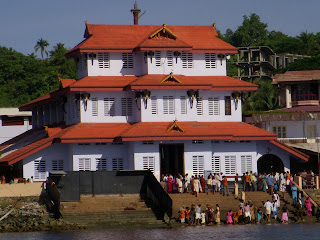
The rich architecture, imposing structure of the temple, with its turrests and gables and the copper plate roofing rises majestically against the beautiful land scape of hills paddy fields and gardens with the river Madhuvahini flowing leisurely in front of it.The Madhur Temple is a Siva temple with Srimad Anantheswara as its presiding deity. But importance is given to the deity Maha Ganapathi. The Sivalingam of the temple is said to have been found by a harijan woman, Madharu.The special festival of the temple is Moodappa Seva, which is covering the large figure of Maha Ganapathi with appam made of ghee and rice. The festival is conducted only periodically in view of the huge expenditure involved. It was celebrated in April 1962, after a lapse of about 160 years, and recently in April 1992.Namaskara Mandapam of the temple has been decorated with beautiful figures of puranic heroes in wood. A closer examination of the wood carvings would disclose the various episodes of the Ramayana, beginning with the Seethga Swayamvaram. The Mantapam in the interior of the temple building as well as the outside facade of the second and third storey of the main building are also profuse with attractive and exquisite wood carvings.

ANANTHAPURAM LAKE TEMPLE


Ananthapuram Lake Temple is the only lake temple in Kerala, which is regarded as the moolasthanam (original abode) of Anandapadmanabha, the deity of Sri Padmanabha Swami temple, Thiruvananthapuram. It is located at Ananthapuram,, 30km from Bekal in Kasargod District.
The deity Shri Padmanabha is in a sitting posture. This temple is associated with the great mystic Vilvamangalathu Swami who is believed to have offered penance at this spot.
The temple which is built on a remote rock is situated in the center of the Ananthapura lake. There is a lone crocodile living in the lake. It is said that when one crocodile dies, another one appears.
The walls of the temple are adorned by murals depicting themes from the Puranas and there is a cave which opens out to a small pond where the water level remains steady regardless of climatic changes.
The original idols in the temple were made of a special combination of a number of medicinal materials known as 'kadu-sharkara-yogam.' These were recast in panchaloha in the year 1972, but now there is a move to reinstall idols made of the original material.
To reach the temple, one has to travel 11 km from Kasargod to Kumbala. From Kumbala, there is a road that leads to Badiadka, and it is a further 3 km to Naikap. The temple is located 1 km from there.

KAPPIL BEACH


Kappil Beach
For those who prefer Thoreau to Harold Robbins, the secluded and relatively unexplored Kappil Beach should prove idyllic. This sun-drenched beach is a perfect getaway after a hectic tour of the nearby Bekal Fort, some six kms away. Adventurous souls can even ascend the nearby Kodi cliff to get a panoramic view of the Arabian Sea.
Nearest Railway Station : Kasaragod, about 12 km

POSSADIGUMPE HILL


Possadigumpe Hill, Possadigumpe is a tourist destination located in the village of Dharmathadka, about 18kms east of Mangalpady town which is at a distance of 25kms north of Kasargod. Nested in a picturesque hillock , 1060 feet (320 meters) above sea level, it is an ideal place for an enchanting one day trip. The scenic vision of Arabian sea and the vast areca gardens of Kasargod extending up to Mangalore city and Kudremukh, from the top of the hill is awfully breath taking

Anandashram

Anandashram Kanhangad, 23kms south east of Kasargod is famous for two ashrams namely Anandashram and Nityanandashram. Founded in 1931 by Swami Ramdas and Mother Krishnabai, endearingly called papa and mataji, Anandashram is about 5kms from Kanhangad in the Mangalore-Shornur sector of southern railway. This internationally renowned spiritual centre housed in a serene atmosphere offers a quiet, peaceful ambience best suited for meditation and spiritual studies. The main ashram building is on an elevated hilly spot. With in the ashram compound, there is a Bhajan hall, a satsang hall, samadhi mandirs, a book stall and an information center. To the new visitors, the information center illustrate a video giving a general idea about the Ashram and its activities. There is also a small beautiful circular garden with a flag post atop which flutters the Ashram insignia with the holy Ram Nam printed on it.

Sunday, November 1, 2009

EZHIMALA


Ezhimala, the capital of the ancient Mooshika kings, is considered to be an ancient historical site. It is a onspicuous,isolated cluster of hills, forming a promontory, 38 kms. north of Kannur.
A flouriIshing sea port and centre of trade in ancient Kerala, it was one of the major battle fields of the Chola-Chera war of the II th century . The hill is noted for rare medicinal herbs. Bordered by sea on three sides, Ezhimala is set to occupy a prominent place in the naval history of the country, consequent to the proposal for ommissioning the Naval Academy here.


There is a famous temple dedicated to Lord Hanuman and the Mount Deli Lighthouse also located here. It is maintained by the Indian Navy . The beach sand is of a different texture and the sea is bluer than in other areas. At the Ettikulam Bay, one can enjoy watching dolphins. Bordered by sea on three sides, Ezhimala is set to occupy a prominent place in the Naval history of the country, consequent to the proposal for commissioning the Naval Academy there. Indian Naval Ship (INS) Zamorin was commissioned here marking Phase I of the Ezhimala Naval Academy project, which was completed in January 2009.

The Prime Minister, Dr. Manmohan Singh, inaugurated the Naval Academy in Ezhimala, Kerala on the 8th of January 2009. The Prime Minister's address on the occasion began with appreciation of this place "It is my profound pleasure to be present here today at this magnificent campus overlooking the Arabian Sea. There could not have been a better place for the establishment of India’s Naval Academy. I am therefore grateful to the Government of Kerala for having made all this possible"

PAITHALMALA

Paithalmala is an enchanting hill station in North Kerala in the Western Ghats near Kerala-Karnataka border. Standing as tall as about 4,500 feet above sea level, the summit is located about 65 kms north-east of Kannur city and 35 kms east of Thaliparamba. North of Paithalmala is the Kudaku forest. These huge mountains lay spread over 500 acres of land enriched with dense forest. The easiest access to the summit is from a place called Kappimala. One can go by bus up to Kappimala and then a bumpy jeep ride of two kilometers through the "muttatham-vayal" mountain till the forest border at "Manja-pullu". A 2 km trekking through the forest will then take you to the summit. The peak offers a spectacular view of the surrounding mountains beneath it. It is also a haven for a wide variety of rare flora and fauna. There are many seasonal waterfalls and brooks in the nearby areas. Paithalmala is an ideal spot for adventure tourism as well.

  • Nearest bus Station : Pottenplave (Buses are available from TaliparambKSRTC is running several buses to Pottenplave from Kannur depot).
  • Nearest Railway Station : Kannur railway station.
  • Nearest Airport : Kannur International Airport 
  • two different directions; pottenplave (near Kudiyanmala) and Kappimala (Near Alakkodu). However, trekking from pottenplave is preferred because of the all-weather motorable road from pottenplave till the beginning of the forest, where the trek starts. There are upcoming resorts on this route too. The drive from Kudiyanmala till Paithalmala valley is refreshing as the winding and narrow road takes you to the higher elevations. Cars can be taken here without a second thought too. Parking at the valley is not guarded but generally safe.
  •  
  • the beginning of the forest, where the trek starts. There are upcoming resorts on this route too. The drive from Kudiyanmala till Paithalmala valley is refreshing as the winding and narrow road takes you to the higher elevations. Cars can be taken here without a second thought too. Parking at the valley is not guarded but generally safe.


ARALAM WILDLIFE SANCTUARY


The sanctuary area falls in Aralam, Kelakam and Kottiyoor revenue villages and is located in the Northwest slopes of Western Ghats contiguous with the forests of Coorg (Kodagu) district of Karnataka state.


Aralam Wildlife Sanctuary Kannur - Location : 35 km from Thalasserry and 60 km from Kannur town.


The Aralam Sanctuary is spread over 55 sq kms of undulating forested highlands on the slopes of the Western Ghats. The highest peak here - Katti Betta - rises to a majestic 1145 m above sea level.
Covered with tropical and semi evergreen forests, the Aralam Sanctuary is home to a vast variety of flora and fauna endemic to the Western Ghats. Herds of deer, elephant, boar and bison are common sights. Leopards, jungle cats and various types of squirrels are also seen here.
Aralam, a village in Thalasserry, is also noted for the Central State Farm, a 3060 hectare farm started in 1971 by the Government of India. This is one of the main production centres of hybrid coconut seeds in the country.
Aralam Wildlife Sanctuary Kannur - Getting there:
Aralam Wildlife Sanctuary Kannur - Nearest railway station : Thalasserry, about 35 km.
Aralam Wildlife Sanctuary Kannur - Nearest airport : Karipur International Airport, Kozhikode about 71 km from Thalasserry town.

KANNUR FORT


St.Angelos Fort is in the west of Kannur town. It was built in 1505 by the first Portuguese Viceroy, Don Francisco De Almeida, with the permission of the Kolathiris, on a promontory jutting into the Lakshadweep sea.The Dutch captured the fort in 1663 and sold it to the Ali Raja of Kannur in 1772 and in 1790 it came into the possession of the British.The British rebuilt it and made it their most important station in Malabar.This fort is in a fairly good state of preservation, though parts of it have collapsed. A few obsolete guns are seen at the place. The fort is a protected monument under the Archaeological Survey of India.

KOTTIYOOR TEMPLE


A very ancient Siva Temple situated here attracts lakhs of devotees every year. The Bavali river, Paalukaachi hill, all are tourists places in Kottiyoor.
According to the Sthala Purana, it is supposed to be the location of the famous Yagna of Daksha, also called the Daksha Yagna or the Dakshayaagam.
The temple festival (utsav) begins every year by mid-May and lasts for 28 days. Ilaneer Veppu or submitting tender coconuts before the deity is an important ritual during the festival. Thousands of tender coconuts brought by hundreds of devotees from different parts of Malabar is submitted on a special day. The very next day is Ilaneerattam. On this day, main priest pours coconut water collected from the tender coconuts on the idol.
Kottiyoor is connected by bus from Thalassery, Kannur (Cannanore) and Mananthavady. Special bus services are arranged during Vaisakha Maholsavam from Thalassery to accomodate the large number of devotees.
If you are coming to Kottiyooor with own transport, the drive to Kottiyoor is very scenic and roads are in good condition. If you are coming from Calicut or Kannur side, reach Thalassery and then take the Koothuparamba, Nedumpoyil, Kelakam road.
If you are coming from Wayanad, Mysore, Bangalore side, reach Bathery and then take the Mananthavady road. From Mananthavady, ask for Kannur Road and drive around 10 kilometers. There will be a road going towards right here and is easy to miss. You will find a sign which says “Boys Town x kms”, you need to turn right here. This is the start of the ghat section (Paal Churam) that will get you down from Wayanad. Another 10 Kms, you will reach a place called Ambayathod. Drive straight to Kottiyoor from here.
Ample parking facilities will be arranged around Sri Kottiyoor temple during the festival season
Distance to Kottiyoor from Major Towns/ City
Kannur (Cannanore) - 70 KmsThalassery - 60 KmsCalicut - 125 Kms
The closest Railway station Thalassery is 60 Kms away. The closest Airport is at Calicut.

PARASSINIKADAVU SREE MUTHAPPAN TEMPLE


Parassinikadavu Muthappan TempleThe famous Muthappan (Siva) Temple (Parassinikadavu Madappura) is on the banks of the Valapatanam river.
According to tradition, the main abode of Muthappan was Puralimala near Mattannur. The story goes that Muthappan appeared in the form of a child before one Padikutti Amma. The child had an insatiable appetite for liquor, fish and meat and became a nuisance to the family was therefore turned out from the house.
Armed with a bow and arrow Muthappan wandered from place to place and eventually reached Puralimala. At Kunnathurpadi, on his way to Puralimala, he climbed on to the top of a palmyra tree near the house of one Chandan and drank toddy.
Chandan who happened to arrive on the scene, is said to have been turned into a rock at the gaze of Muthappan. Here Muthappan completely disappeared from the scene and nothing more was heard of completely disappeared from the scene and nothing more was heard of him. It is believed that he came down to Parassinikadavu.
According to tradition, a member of the Vannan community at Parassinikadavu found a metallic arrow on the trunk of a Kangira tree and having felt something divine about the place, reported the matter to the senior member of an ancient Thiyya family in the neighbourhood. The latter, who felt the divine presence of Muthappan, immediately performed the necessary ceremonies and offered worship to him.
It is an accepted dictum here, that whatever is received by way of gifts or offerings should be spent for the benefits of the pilgrims. The daily offerings made to Muthappan are also different from what they are in other temples. It has been customary to offer toddy, fish and meat as 'nivedyams' to this deity. People of all castes and communities including
People of all castes and communities including members of the Muslim as well as Christian communities are known to donate sums of money as vazhipadu of Muthappam. The annual festival which falls on December 1st, provides a special occasion for pilgrims to throng the Parassinikadavu temple.
The temple is situated 20 kms, north of Kannur town.

THIRUVANGAD SREE RAMA TEMPLE


Thiruvangad Sree Rama Temple known as the brass pagoda is situated in the Thalassery town 2 kms east on kodiyeri route. Sree Rama the main deity having six feet height granite idol. Hanuman, Subramanya, Ganapathy, Vishnu, Vana Sastha, Bhagavathy Sivan ( Separate Shrine) are other dieties. Main and popular vazhipadu is kalabham charthal. Valiavattala payasam, avil nivedyam are also important. Annual festival is in April and May, commences on Meda samkramam for eight days. Kathakali, Chakyar Koothu, are performed on all days in addition to the temple rituals. This well maintained temple has excellent wood carvings, terracota art work, mural paintings carved on wooden planks in the ceilings are a repository of art treasure. the big temple tank is a rare one and useful to the devotees. sathram, guesthouses for stay and kalyana mandapam are also well maintained

PERALASSERY TEMPLE


Located 14 km from Kannur, the Subramania Peralassery Temple marks the place where Sri Rama along with Lakshman halted on their way to free Sita from the clutches of Ravana in Lanka. The temple has a number of bronze and copper idols of snake everywhere. There is also a temple tank worth seeing in this place.

JAGANATH TEMPLE, THALASSERY


This temple is dedicated to Lord Siva was consecrated in February 1908 by the great religious reformer Sree Narayana Guru. The temple festival is held during February/March.

TRICHAMBARAM TEMPLE


Trichambaram Temple is situated 20 km from Kannur district of Kerala state, south India. It is near Taliparamba town, famous for its spices trade. The temple is believed to have got the name from Thiru Shambara or the holy shambara in reverence to Maharishi Shambara.
The deity of the temple is Krishna. The sculptures on the walls of the sanctum sanctorum are a class by themselves. The temple also contains one of the most exquisite collection of mural paintings in south India. Trichambaram Temple has three ponds attached to it, with the temple for Durga being surrounded by water on all sides.

The annual temple festival (Utsavam) is a colourful event. The fortnight-long festival begins on Kumbham 22 of Malayalam calendar (which generally falls on March 6) every year with the kodiyettam (hoisting of a religious flag) and comes to an end on Meenam 6 (which generallay falls on March 20) with Koodipiriyal (Ending of this festival). In between these dates, for 11 days, thitambu nriththam (a sort of dance with the deities of Krishna and Balarama) is held at Pookoth Nada (1 km from Trichambaram temple).